The Convergence of 'AI Science' and 'Taiji Art'

TaijiFlow AI
Silk Reeling Assistant

"Mindful solo Taijiquan practice, guided by artificial intelligence."

Bridging traditional Taiji philosophy with biomechanical principles into an intelligent Silk Reeling training system, empowering authentic and correct practice.

12×12 Forms & Principles (12 Silk Reeling Forms & 12 Rules)
Real-Time Instant Guidance (Seamless in-browser motion feedback)
Webcam Standard Hardware (Using webcam, no wearables needed)
100% Complete Privacy (100% On-Device, No Recording)
💡 AI serves as a training companion—not a substitute for qualified masters, nor a medical diagnostic tool.

About Project

Bridging ancient martial arts mastery with state-of-the-art edge computer vision

Origins & Scientific Vision

01 📜 Origins & Vision

Empowering aging societies through biomechanically informed Taiji motion analysis

🌿 Inspiration & Aging Society

Global demographic shifts toward an aging society highlight the paramount importance of mobility, balance maintenance, and fall prevention to preserve independence and quality of life.

  • Extensive medical research supports Taijiquan for improving balance and proprioceptive awareness.
  • Chen-style Silk Reeling (Chan Si Jin) is a foundational discipline of continuous spiral motion.
  • Relies on harmonious coordination between weight shifting, waist rotation, and center-driven movement.
  • A nuanced somatic skill that is historically challenging to learn and verify during solo home practice.

🔍 Problem Significance

During solo practice using video recordings or online media, practitioners encounter three fundamental limitations that impact correctness and safety:

  • Abstract tacit knowledge that is difficult to translate into verifiable biomechanical execution without in-person adjustment.
  • Limited continuous access to qualified master coaching due to geographical, financial, and time constraints.
  • Complete lack of real-time kinematic feedback to detect subtle errors during practice execution.
  • Standard 2D videos cannot reveal 3D joint alignment discrepancies or offer personalized postural corrections.

🎯 Objectives & Solution

TaijiFlow AI translates ancient movement wisdom into computational representations, functioning as an intelligent biomechanical mirror for confident and safe practice:

  • Interdisciplinary framework bridging clinical biomechanics, computer vision, and martial arts wisdom.
  • Real-time movement quality assessment via standard webcams without requiring wearable sensors.
  • Maximum user privacy guaranteed through 100% in-browser Edge AI computation without video recording.
  • Serves as an educational companion and coaching aid; not a replacement for medical advice or master instruction.

Technology & System Architecture

02 🧠 Tech & Architecture

Zero-server Edge AI processing directly in browser with 100% user privacy preservation

✨ Key Features

An intelligent biomechanical system integrating scientific precision with contactless tracking to deliver an authentic, accurate, and safe training experience:

  • Pose Detection - Real-time 33-point body tracking
  • Body Calibration - Calendarize to user's body proportions
  • 12 Rules Analysis - Verify correctness against 12 biomechanical rules
  • Real-time Feedback - Instant error notification via visuals and audio
  • Practice Insights - Session summary and actionable guidance for long-term improvement

💻 Technology

Driven by modern Edge AI and Computer Vision pipelines operating entirely within the user's web browser, delivering real-time responsiveness with absolute privacy protection:

  • MediaPipe Pose - Computer Vision, 33 Landmarks Detection
  • MediaPipe Gesture - Hand Gesture Recognition & Control
  • Heuristic Biomechanical Engine - Decode Taiji principles into 12 biomechanical rules
  • Web Speech API - Text-to-Speech system for real-time audio guidance
  • Edge-Native AI & WebGPU - In-browser execution with ultra-low latency (<100ms)

🏗️ System Architecture

A unified closed-loop pipeline seamlessly coordinating visual sensor input, kinematic analysis, multi-modal feedback, and longitudinal progress tracking:

  • Input: Video Stream from Webcam with automatic body calibration
  • Processing: Extract 33 Keypoints via MediaPipe Pose and analyze kinematics via 12 Heuristic Rules in-browser
  • Output: Visual trajectory guidance, audio feedback (TTS), and Practice Insights for sustainable progress

Development Roadmap & Milestones

03 🗺️ Project Roadmap

From Proof of Concept to clinical RCT trials for international medical rehabilitation

Phase 1 Proof of Concept 2024–2025
12 Forms & Calibration
Phase 2 Scaling & Production 2025–2026
ST-GCN AI & Clinical RCT
3
Phase 3 Intelligent Coach & RCT 2026–2029 (Ph.D.)
✅ Completed

Phase 1: Proof of Concept (2024–2025)

Master's Independent Study proving the feasibility of an in-browser Heuristic Biomechanical Engine evaluating 4 Single-Hand Silk Reeling forms with 9 foundational rules.

  • First-ever Heuristic Biomechanical Engine prototype developed for Taijiquan
  • Evaluation of 4 Single-Hand Silk Reeling exercises across 3 posture levels (seated, standing, squatting)
  • Mathematical decoding of classical principles into 9 algorithmic heuristic rules
  • Web prototype engineered under ISO/IEC 29110 software development standards
📦 Production Release

Phase 2: Scaling the System (2025–2026)

Funded research expanding to all 12 Silk Reeling exercises (single & double hand) with 12 comprehensive biomechanical rules, Body Calibration, and Practice Insights (TRL 5–6).

  • Full coverage of all 12 standard Chen-style Silk Reeling forms (4 single-hand + 8 dual-hand)
  • Synthesis of 12 universal biomechanical rules covering spinal axis and bilateral coordination
  • Dynamic automated body calibration adapted to personal anatomical proportions
  • Implementation of Practice Insights, Instant Replay, and secure Supabase landmark pipeline
🎓 Current Ph.D. Research — In Progress

Phase 3: The Intelligent Coach (2026–2029)

PhD doctoral research deploying Spatio-Temporal Graph Convolutions and clinical RCT trials to evaluate motor learning and postural balance outcomes.

  • Edge temporal sequence AI (ST-GCN + Self-Attention Transformer) accelerated via WebGPU
  • Neuro-Symbolic Explainable AI mechanism generating verified actionable pedagogical coaching
  • Formal SOP protocol preparation and Institutional Review Board (IRB) ethics certification
  • Efficacy evaluation via Pilot Randomized Controlled Trial (RCT) in practitioner cohort

Knowledge Hub

Unified knowledge ecosystem: 90-node AI biomechanical neural graph and research roadmap.

3 Interconnected Ecosystem Platforms

01 Knowledge Portal

Connecting Academy, Software Architecture, and PhD Clinical RCT Research
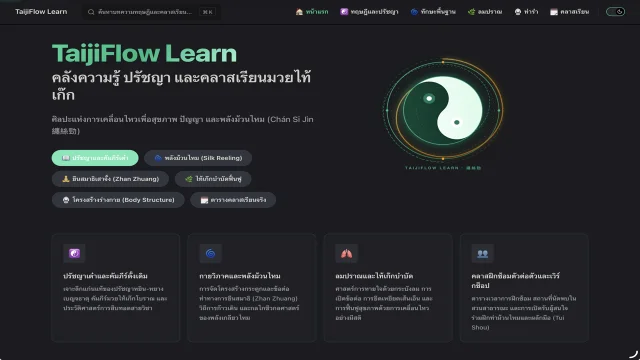
learn.taijiflow.org
ACADEMY
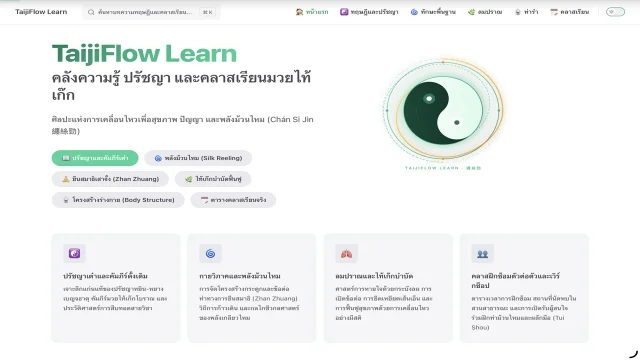
TaijiFlow Learn Portal Interface TaijiFlow Learn Portal Interface

Learning Center

Traditional Chen-style Taijiquan knowledge repository, deep-diving into Silk Reeling mechanics, Zhan Zhuang standing meditation, and community park schedules

📜 Taoist Philosophy 🌀 Silk Reeling 🧘 Zhan Zhuang 🗓️ Park Classes
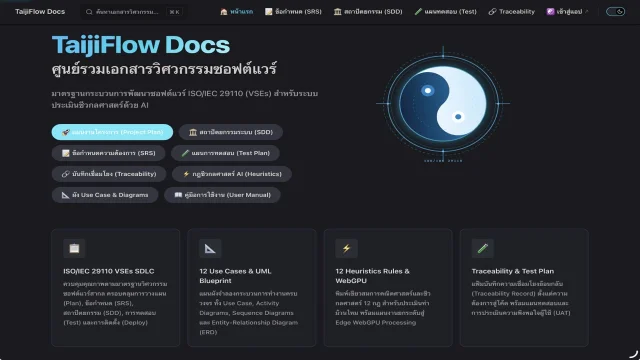
docs.taijiflow.org
ISO 29110
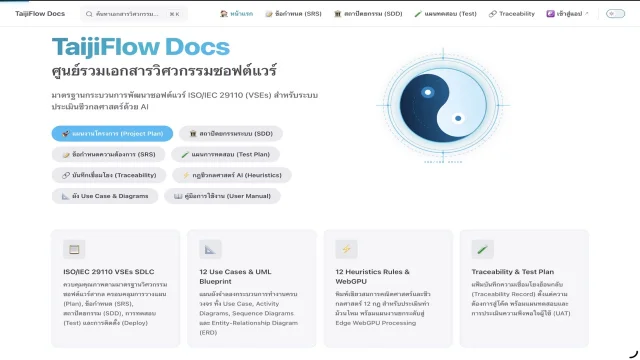
TaijiFlow Developer Documentation Interface TaijiFlow Developer Documentation Interface

Developer Docs

Software engineering repository adhering to international ISO/IEC 29110 VSEs, containing SDD architecture, 12 Use Cases, and 12 AI biomechanics blueprints

🏛️ ISO 29110 Standard 📐 SDD Architecture ⚡ 12 Biomechanics Rules 🧪 Test & Verification
research.taijiflow.org
ST-GCN AI
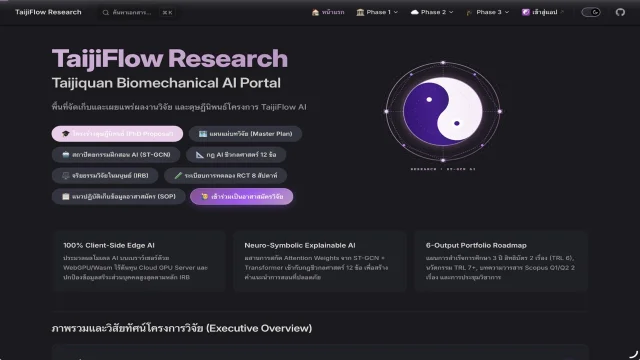
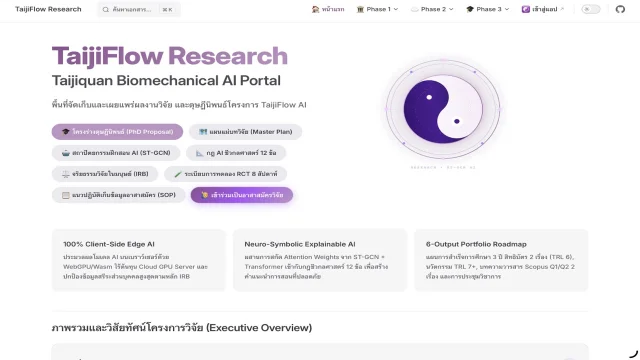
TaijiFlow Biomechanical AI Research Portal TaijiFlow Biomechanical AI Research Portal

Research Data

Doctoral research portal for ST-GCN edge neural networks via WebGPU, Institutional Review Board (IRB) human ethics compliance, and clinical RCT trials

🎓 PhD Dissertation 🧠 ST-GCN AI Model ⚖️ IRB Ethics Protocol 📊 8-Week RCT Trial

Interactive 90-Node Biomechanical Neural Graph

02 Neural Synapse Graph

Explore cross-domain synapses between biomechanics, AI, and PhD research with full-screen focus

Knowledge Dimensions 90 Nodes
Drag to Pan • Right-click to Rotate • Scroll to Zoom • Click Node to Analyze

3 Research Pillars & Startup Translation

03 3 Research Pillars

From biomechanical laboratory research to clinical RCT trials and commercial spin-off

🏛️ 01
Pillar 01 Taiji Biomechanics
3D Kinematics
02
Pillar 02 Edge AI & Vision
Clinical RCT
🔬 03
Pillar 03 Clinical Trials
🏛️
PILLAR 01

1. Taiji Biomechanical Foundations

Decoding 12 Silk Reeling forms & 12 heuristics into 3D kinematic models.

PILLAR 02

2. Edge AI & Computer Vision

Real-time in-browser pose estimation with MediaPipe 33 points & ST-GCN.

🔬
PILLAR 03

3. 8-Week Clinical RCT & PhD

CMU REC ethical clearance, BBS/SLS/TUG balance outcomes & Scopus Q1 thesis.
User Guide

Explore the real-time AI processing pipeline, 33-joint biomechanics simulator, and live app preview

5-Phase Real-Time AI Movement Pipeline

01 ⚡ AI Pipeline

Frame-by-frame joint angles, angular velocities, and weight distribution analysis with Privacy-First Edge AI

PHASE 01: MONOCULAR RGB INPUT
30.4 FPS 12ms LATENCY EDGE ON-DEVICE
LIVE RGB STREAM • 1080p R_WRIST (x,y,z) ดึงกระหม่อม (↑Z) จมไหล่ทิ้งศอก (↓G) จุดศูนย์ถ่วง ตันเถียน (Core) เต็ม (70%) ว่าง (30%) ST-GCN • 120-FRAME ATTN INSTANT FEEDBACK "ผ่อนศอกลง 3° • ถ่ายน้ำหนัก 70%" ⚡ MUSCLE MEMORY ADAPTATION
01 // MONOCULAR INPUT 01

Monocular 2D RGB Webcam

Accessible without costly wearable suits. Operates on any standard laptop or mobile camera with 100% on-device client-side inference for uncompromising privacy.

🔒 100% Client-Side Edge ⚡ 0ms Network Latency 🚫 No Video Stored
02 // COMPUTER VISION 02

33 3D Skeletal Landmarks Extraction

Computer vision models extract 33 spatial joints (x, y, z, v) at 30+ FPS in real time, tracking the central spinal axis, shoulders, elbows, and center of mass.

🎯 33 3D Keypoints ⚡ 30+ FPS Smooth Tracking 📐 Auto Spine Calibration
03 // BIOMECHANICS ENGINE 03

Mathematical Formalization of 12 Biomechanical Rules

Translating ancient Taiji classics into rigorous vector mathematics across all 12 biomechanical rules (demonstrating core foundation rules: suspended crown vertical alignment, sunk shoulders/elbows, pelvic kua neutrality, dynamic 70/30 weight distribution, and kinematic continuity).

🧭 Suspended Crown ⚖️ Sunk Elbows 🥋 70/30 Yin/Yang Root
Explore all 12 biomechanical rules and vector formulas → →
04 // TEMPORAL AI 04

ST-GCN & Spatio-Temporal Transformer

Graph Neural Networks analyze movement trajectories across sequential time frames, evaluating silk reeling spiral continuity and smoothness against expert kinematics.

🧠 Spatio-Temporal Graph (ST-GCN) 🌀 3D Spiral Trajectory ⚡ WebGPU Acceleration
05 // MOTOR LEARNING 05

Closed-Loop Motor Adaptation (Closing the Loop)

Real-time multimodal feedback cues the practitioner instantly during movement, enabling neuromuscular adaptation and reinforcing correct muscle memory safely.

🔄 Closed-Loop Feedback 🔊 Real-Time Voice TTS 📈 Muscle Memory Retention

Interactive 3D Kinematic Pose Simulator

02 🔬 Biomechanics Simulator

Interactive joint manipulation, kinematic trajectory verification, and comparative before/after analysis

AI Skeleton Simulator

Real-time simulation of 33 anatomical landmarks and kinetic alignment

Inspect Biomechanical Principle:
Optimal Alignment: Sunken Elbow, Waist Leading
AI Precision: 98%
Elbow Level -12 cm (จมศอก)
Shoulder Tension ผ่อนคลาย (Relaxed)

Pose Comparison Slider

Interactive split-slider contrasting optimal biomechanics against common postural faults

Optimal Form (98%)
虚领顶劲 (Suspended Crown)
✓ Spinal Decompression
Optimal joint space, kinetic chain flows from root.
⚠️ Common Fault (42%)
Forward Head (Neck Strain)
⚠️ Floating Elbow & Strain
Blocks kinetic transmission, strains trapezius.
🛑 Risk Factors

Elbow higher than shoulder causes rotator cuff tension and disrupts kinetic flow from waist.

🌿 Taiji Principle

Sunken elbow allows Qi to sink to Dan Tien, keeping joints flexible and spine decompressed.

Web Application Training Assistant Interface

03 🖥️ Live App Interface

Real-world practice dashboard, live auditory guidance, and post-session biomechanical scorecard

ai.taijiflow.org
AI INTERACTIVE
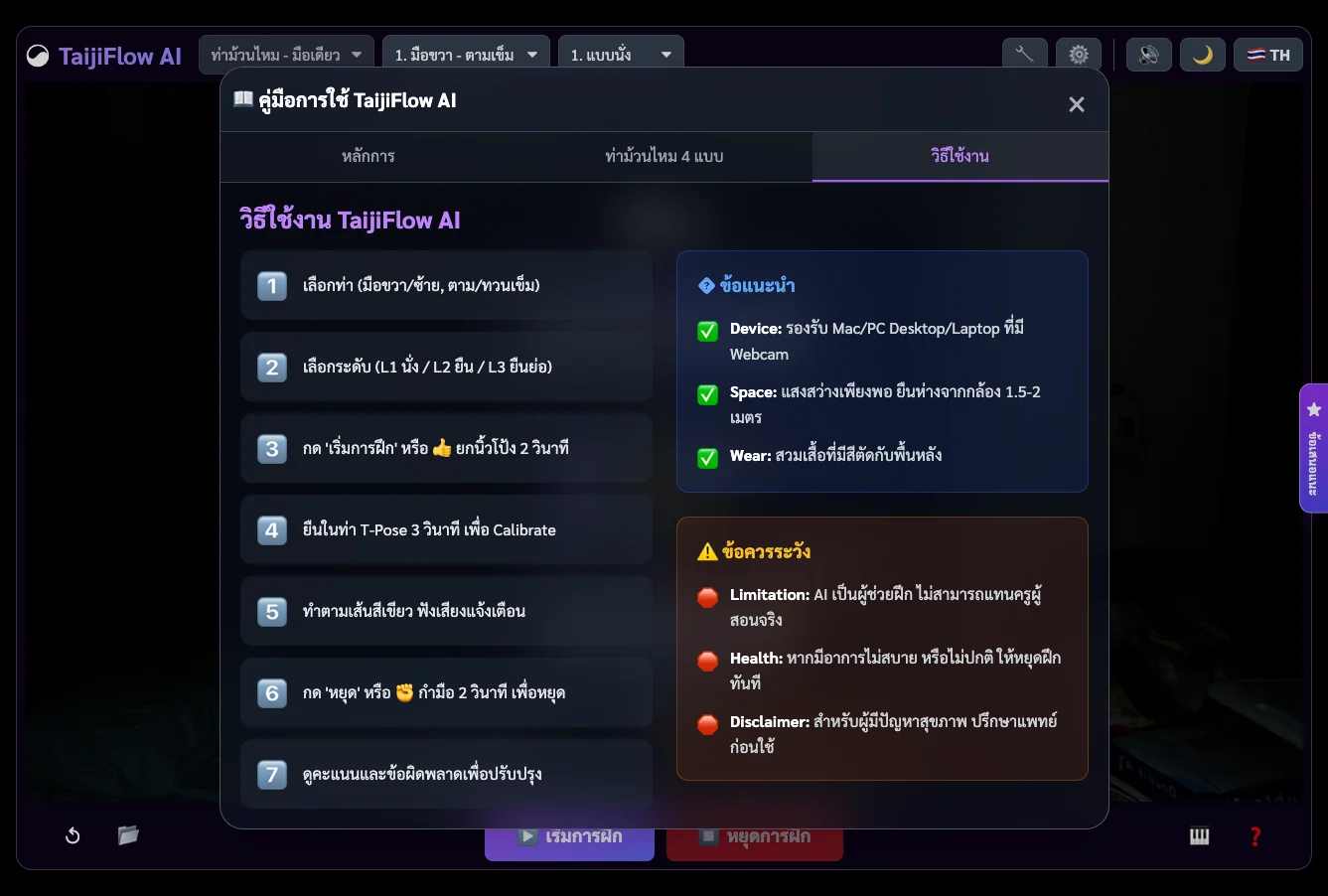
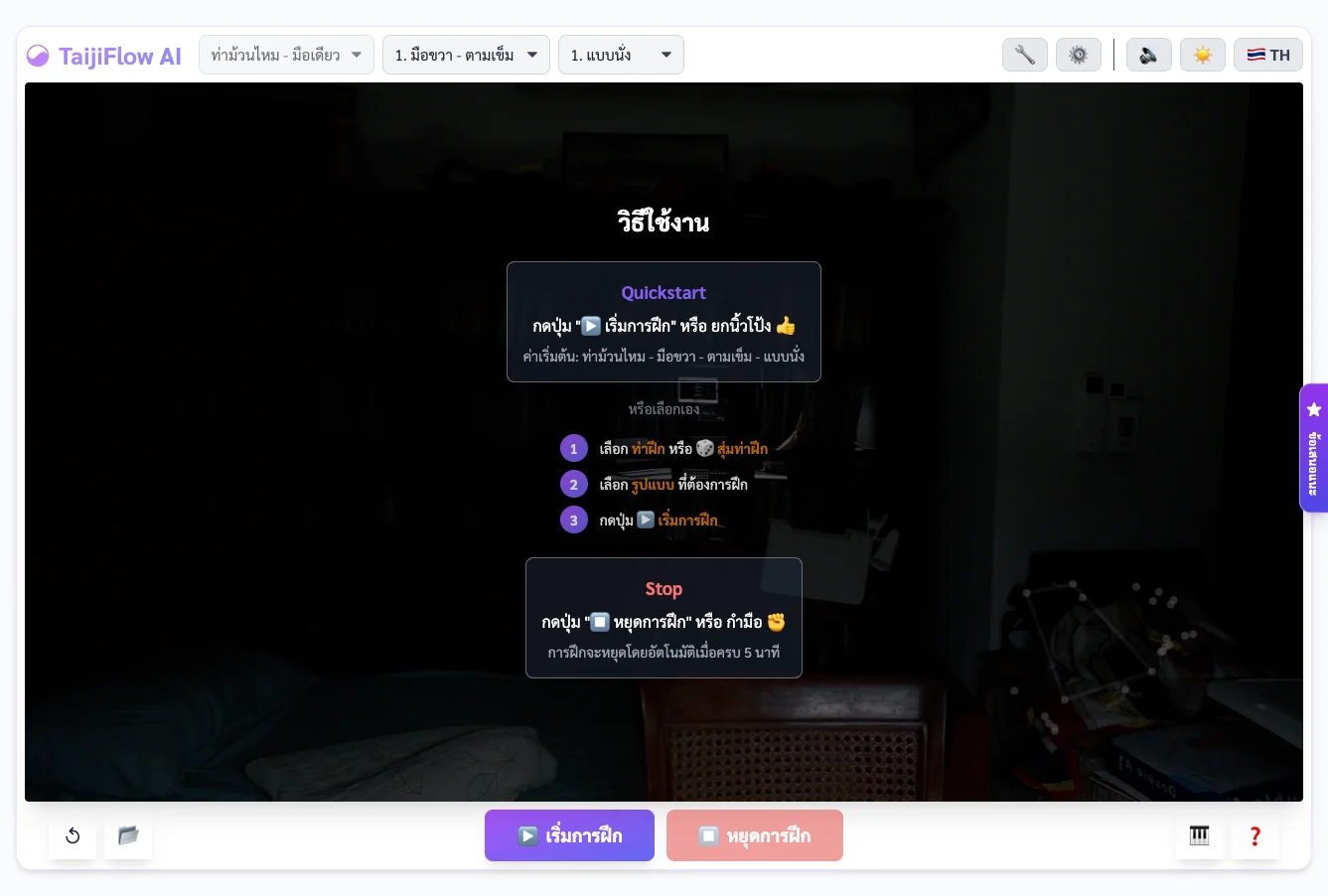
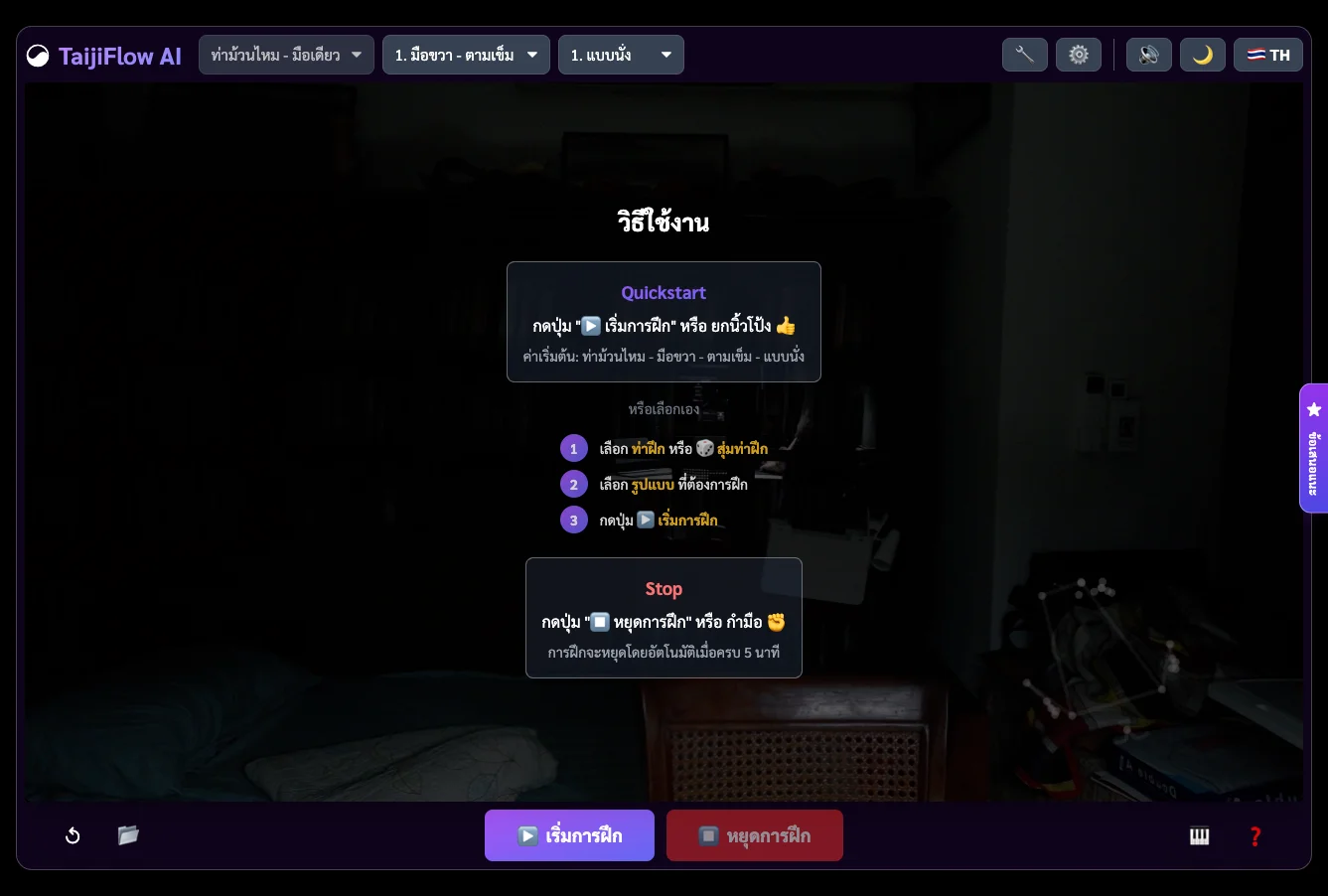
TaijiFlow AI Onboarding & Gesture Controls (Light) TaijiFlow AI Onboarding & Gesture Controls (Dark)
TaijiFlow AI Live Training (Light) TaijiFlow AI Live Training (Dark)
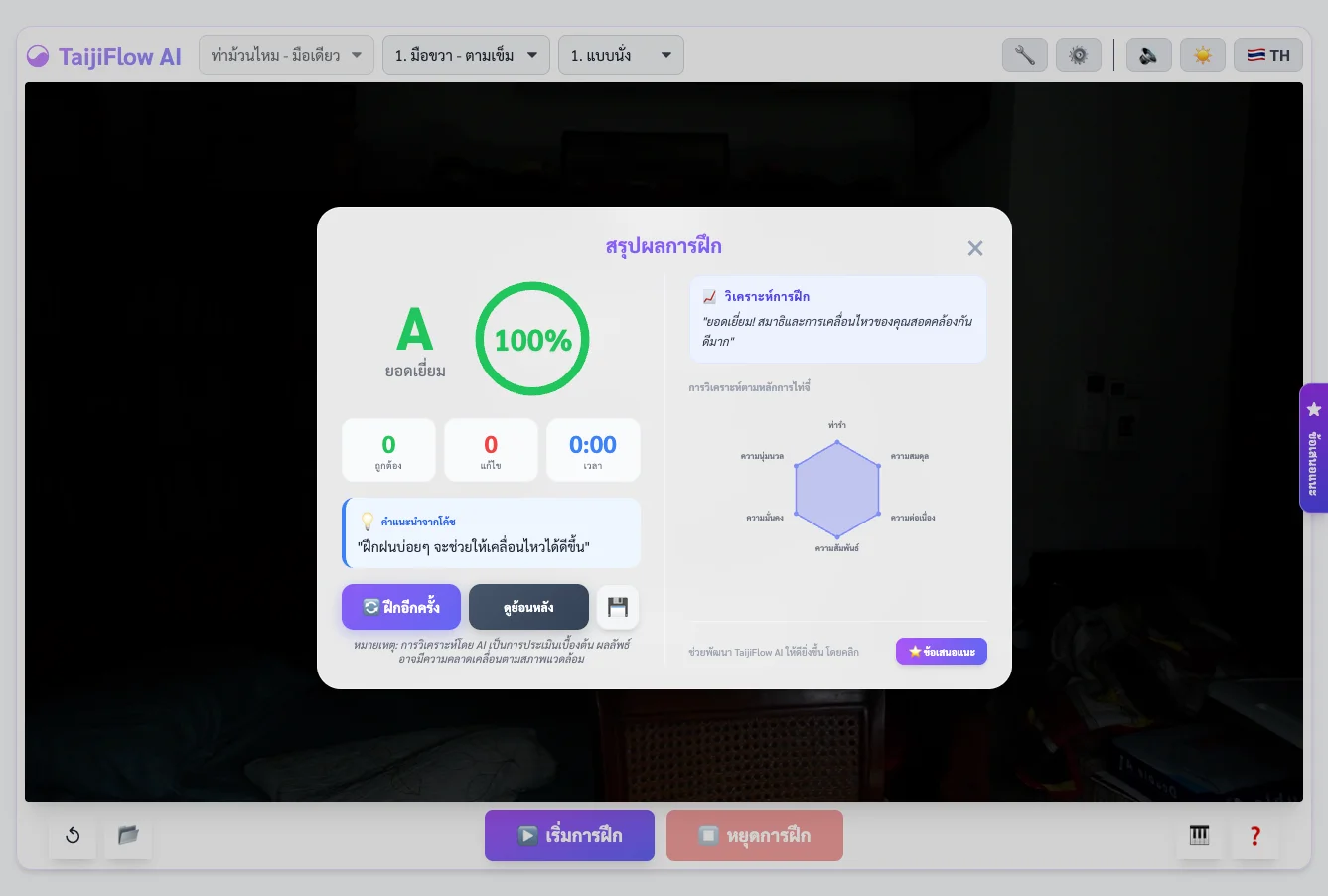
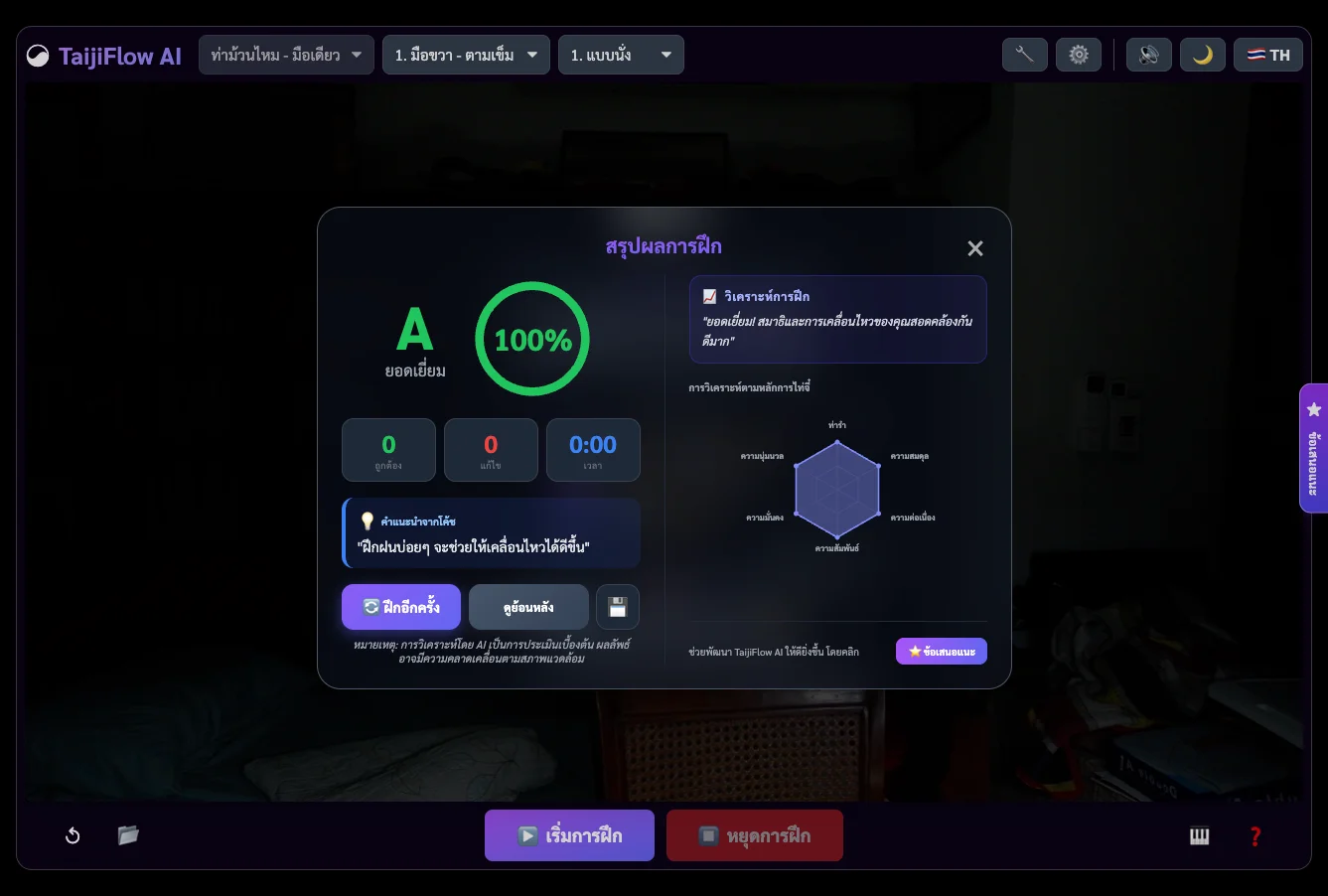
TaijiFlow AI Scoring Summary (Light) TaijiFlow AI Scoring Summary (Dark)
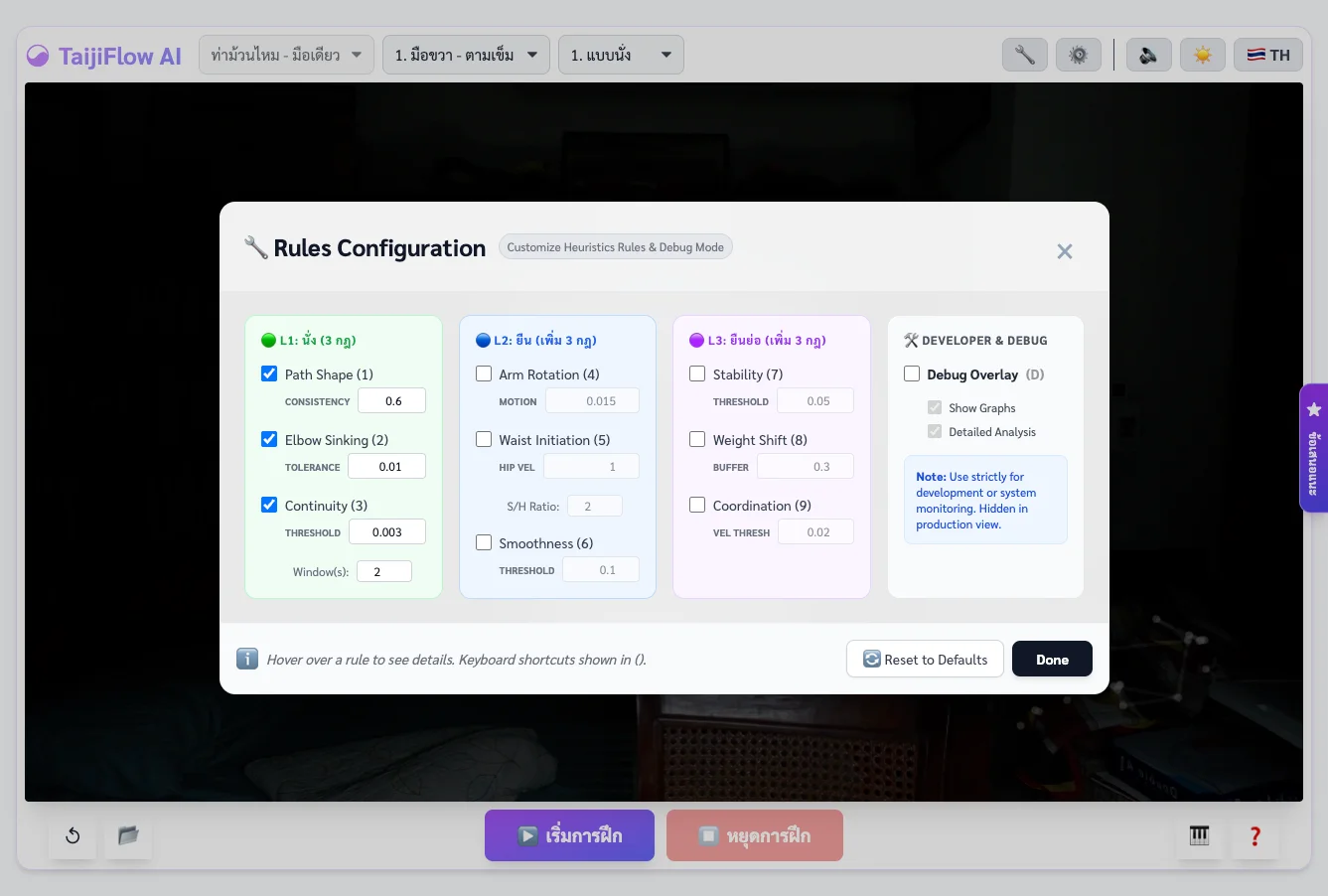
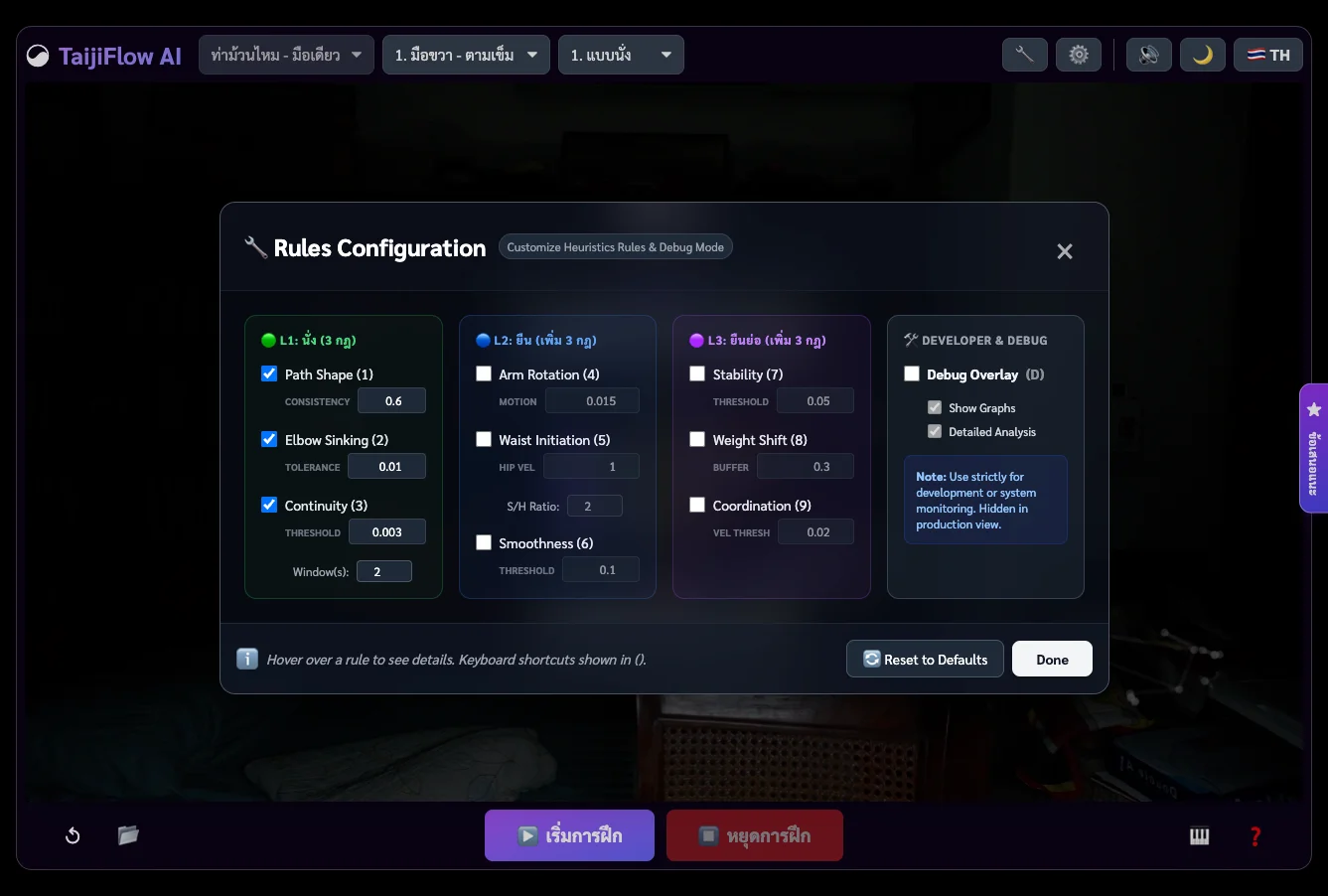
TaijiFlow AI 12 Heuristic Rules (Light) TaijiFlow AI 12 Heuristic Rules (Dark)
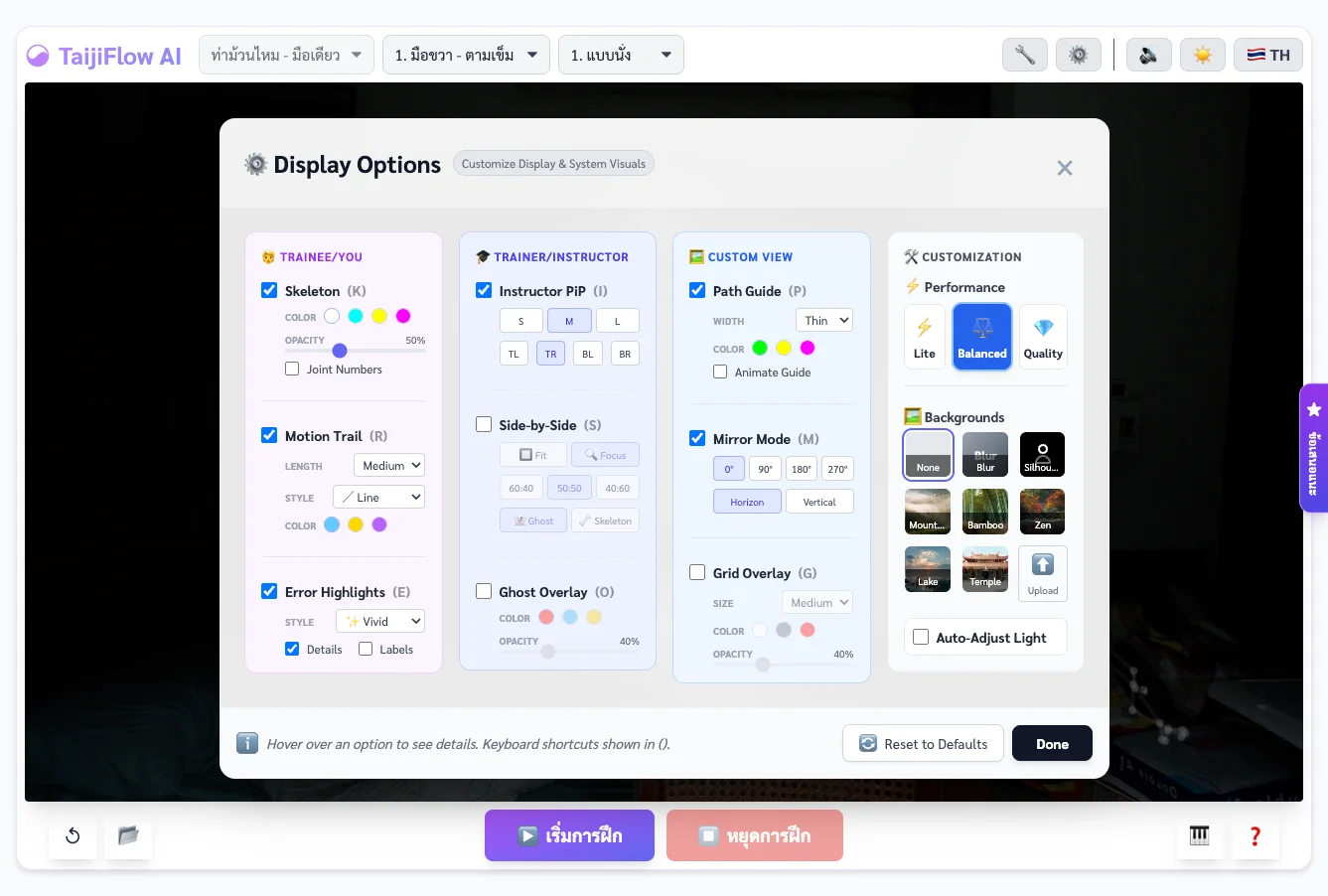
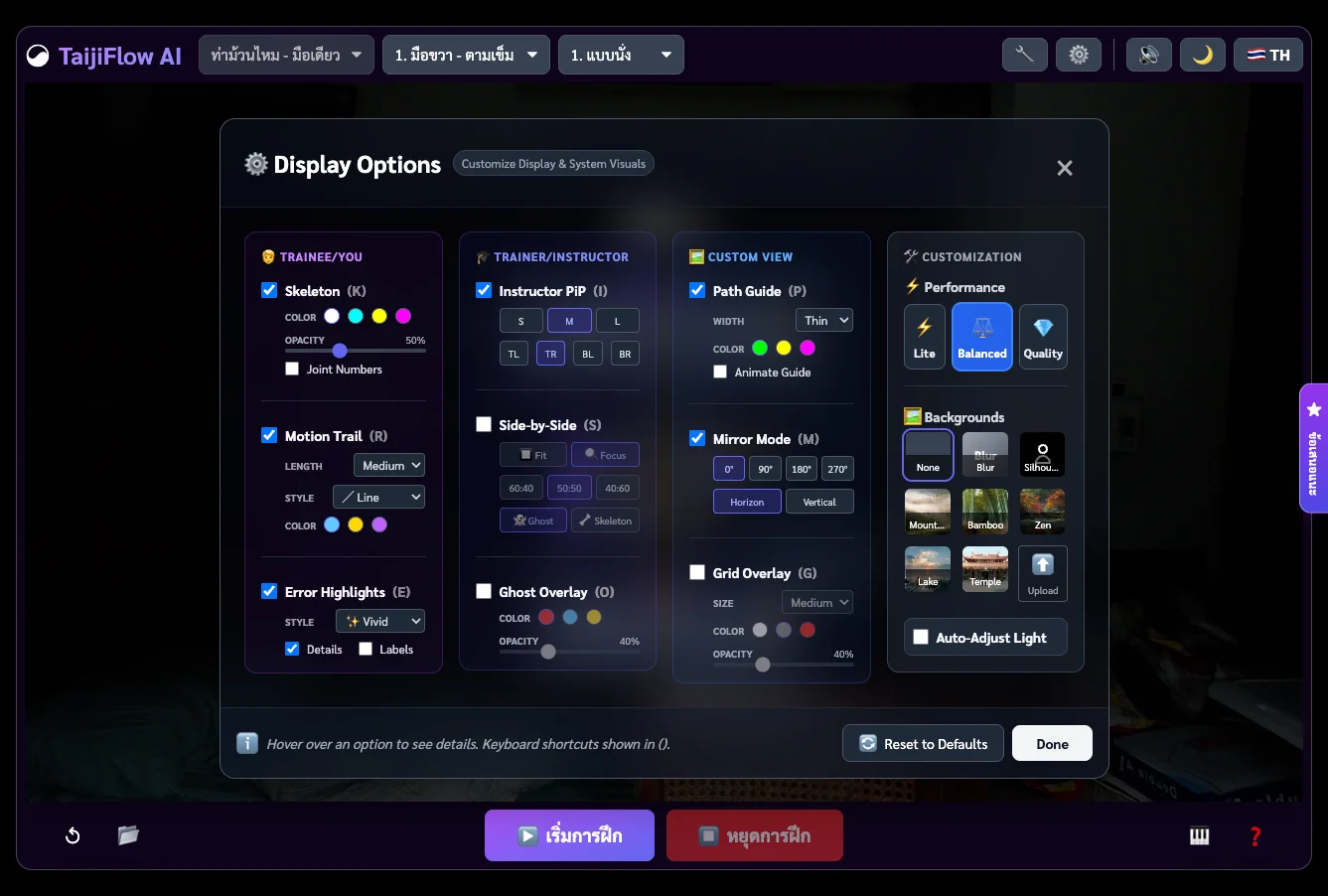
TaijiFlow AI Display Settings (Light) TaijiFlow AI Display Settings (Dark)
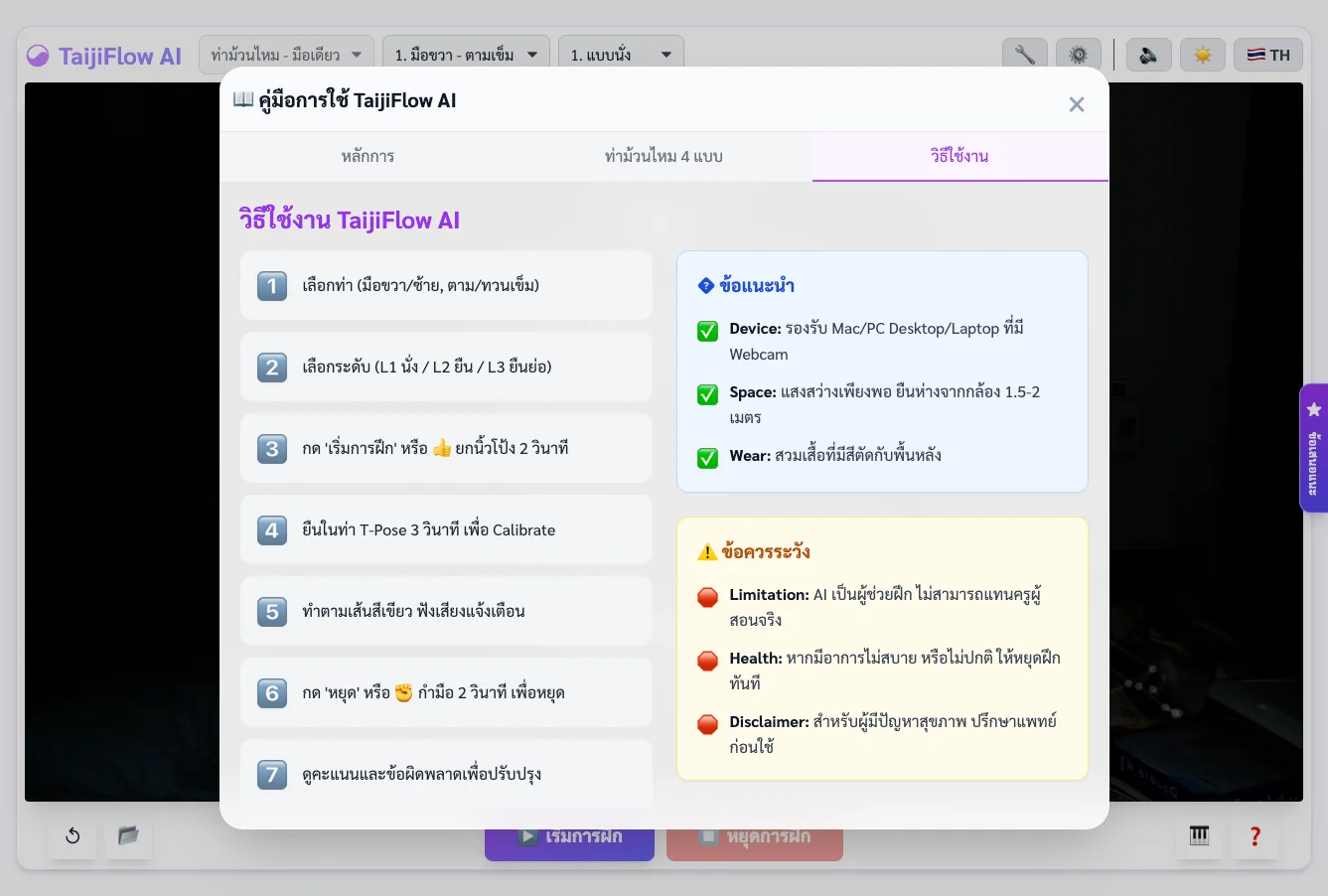
01 // Onboarding

Quick Guide & Gestures

👍
Hand Gestures: Start & stop practice hands-free
📐
T-Pose Calibration: 3s calibration for custom arcs
🛡️
Safe Distance: Stand 1.5–2m with clear lighting
02 // Live AI Vision

Live Pose Tracking Arena

🌐
33 AI Keypoints: Real-time joint tracking precision
🎯
Ghost Guide: Target silk reeling trajectory arc
🔊
Instant Cues: Real-time audio & visual correction
03 // Kinematics Score

Kinematic Assessment

🕸️
6-Axis Radar: Balance & sunken elbow scoring
📈
Precision Timeline: Deviation trends per second
🏷️
Targeted Focus: Actionable cues for next session
04 // Heuristic Rules

12 Biomechanical Rules

⚖️
Strictness Levels: Easy, Standard, or Strict
🧬
12 Core Rules: Sinking elbows, waist & rooting
💡
Live Toggle: Switch rules on/off during training
05 // Visual Settings

Visual Customization

🪞
Mirror Mode: Move naturally like a dance mirror
📐
Live Angles: Real-time elbow & shoulder degrees
👁️
Custom HUD: Toggle skeleton & adjust opacity

Learn More

Deep-dive into Taoist philosophy, edge AI architecture, and frequently asked questions

Still have questions?

If you have any questions regarding practice, usage, or suggestions, feel free to contact the TaijiFlow AI team directly.

✉️ Send us a message →

What is Silk Reeling (Chan Si Gong)?

Silk Reeling (Chan Si Gong) is the core of Chen Style Taijiquan. It fuses body, mind, and energy into one unified movement, like silk reeling from a cocoon:

  • Continuous: Smooth, connected, non-stop movement
  • Softness: Gentle, relaxed, but with hidden power
  • Spiral: Spiraling energy from feet through waist to hands

Key Principles

Correct movement requires Whole Body Connection:

  • Circular Motion: Move in arcs, avoid straight lines
  • Waist as Axis: Use the "Waist" as the driver
  • Upper-Lower Connect: Upper and lower body work in harmony
  • Internal Qi: Use "Mind" to lead "Qi"

Benefits

Consistent practice benefits both body and mind:

  • Coordination: Improve body coordination and connection
  • Balance & Structure: Enhance physical balance and structural stability
  • Mental: Reduce stress and focus via Moving Meditation
  • Energy Flow: Improve Qi flow, the heart of Silk Reeling

How does AI evaluate movements using a standard webcam?

The system uses MediaPipe Pose to extract 33 skeletal landmarks in real-time at 30–60 FPS, calculating kinematic correctness via our in-browser Heuristic Biomechanical Engine for joint angles, trajectory circularity, and waist initiation without expensive specialized hardware.

What do the 12 Biomechanical Rules evaluate?

It covers 9 single-hand rules (trajectory circularity, sunken elbow, waist initiation, vertical spine stability, smoothness, continuity, weight shift, upper-lower coordination) and 3 two-hand rules (bilateral symmetry, opposition & phase difference, and bimanual hand coordination).

Is webcam video recorded or sent to any server?

100% Safe (On-Device Edge Computing): All Computer Vision and pose estimation occurs purely inside your browser via WebGL/WebGPU. Raw video stream is never recorded, stored, or sent to any cloud server.

Can TaijiFlow AI replace qualified human masters?

Absolutely not, and never intended to: TaijiFlow AI is designed as an Intelligent Practice Companion—a biomechanical mirror for home practice to prevent bad postural habits between classes. Learning with qualified human masters remains indispensable for internal energy transmission and refined martial nuances.

What can the AI NOT evaluate? (System Limitations)

The system solely analyzes external body kinematics (joint angles, spatial trajectory, and waist rotation). It cannot measure internal Qi flow, listening energy (Ting Jin), or interactive push hands (Tui Shou). Moreover, it is not a medical diagnostic device; individuals with pre-existing conditions should consult a physician.

Who benefits most from TaijiFlow AI?

1) Solo Home Practitioners: lacking full-length mirrors who need immediate kinematic feedback, 2) Taiji Students: looking to reinforce proper posture between formal classes, and 3) Seniors & Wellness Seekers: aiming to enhance structural stability, prevent fall risks, and cultivate moving meditation.

How is kinematic data used, and how is personal privacy safeguarded?

Highest Privacy Standards: All webcam video is processed entirely inside your local browser (Edge-Native) and never transmitted or stored externally. Only anonymized kinematic coordinates are sent to academic databases if you voluntarily opt in as a research volunteer, strictly abiding by international research ethics and data protection standards.

Why is Body Calibration required before training?

Every practitioner has different height, shoulder width, and arm length. A quick 3-second T-Pose calibration scales the golden trajectory path and error thresholds to fit your individual body geometry perfectly.

Ideal Environment & Setup for Training

Use any modern desktop or laptop with a webcam. Stand 2–3 meters away with full body visible from head to ankles, maintain good lighting, and wear clothes that contrast with your background.

Safety & Medical Disclaimer

TaijiFlow AI is an interactive motion assistant and training tool, not a medical diagnosis device. If you have joint pain, injuries, or medical conditions, consult a physician before practice, and pause immediately if you experience dizziness or fatigue.

Activities & Support

Engage in community classes, contribute as research volunteers, and support open innovation

🗓️ On-site Community

Taiji Practice Classes

Practice authentic Chen-style Taijiquan with master instructors on Saturday mornings. Covers foundational Silk Reeling, Laojia Yilu, Erlu, and traditional weapons in a supportive community.

🔬 Online Research Study

Research Volunteers

Practice 12 Silk Reeling forms at home via webcam to advance healthcare AI research. Bonus: Volunteers receive a complimentary personalized kinematic movement report.

🍵 Non-Profit & Support

Support the Project

All contributions directly support server and AI infrastructure costs, ensuring TaijiFlow AI remains 100% free and ad-free for community health and learning.

🍵 Support the Developer